Nutrient Cycles
What Are the Processes and Features of the Water Cycle?
Teacher Note: Connections
In this concept, students will study the flow of matter through cycles. They learn that matter cannot be created or destroyed. It only moves between one place and another place. Help students see that matter can travel through different paths in the cycle by drawing flow charts on the board. Fill in the flow charts as students study each possible step of the cycle.
As students read and comprehend complex texts, view the videos, and complete the interactives, labs, and other Hands-On Activities, have them summarize and obtain scientific and technical information. Students will use this evidence to support their initial ideas on how to answer the Explain Question or their own question they generated during Engage. Have students record their evidence using My Notebook.
The Water Cycle
More than 97 percent of all water on Earth is stored in the oceans as salt water. However, humans and many other organisms depend on fresh water for survival. Indeed, fresh water is one of Earth’s most precious resources. The total amount of water on Earth is constant and continuously moves through the water cycleglossary term (opens in a new window). Parts of the water cycle transform salt water into fresh water that can be used by living organisms.
The water cycle (also called the hydrologic cycle) includes three primary processes: evaporation, condensationglossary term (opens in a new window), and precipitation. Evaporation refers to the transformation of a liquid to a gas. In the water cycle, the sun heats up water in oceans, lakes, rivers, streams, and other aquatic bodies, resulting in evaporation during which liquid water evaporates into water vapor. Evaporation also takes place from the leaves of plants. This form of evaporation is called transpiration. Plants play an important role in determining the rate of evaporation from vegetated areas.
Although the concentration varies, air always contains a certain amount of water vapor. The amount of water in the air is called humidity. The amount of water that can be held by the air depends upon temperature. The warmer the air, the more water it can hold. When air is holding the maximum amount of water at a certain temperature, it is said to be saturated.
Teacher Note
Students encounter the water cycle every day. Use the Connect the Dots strategy to help them identify common parts of the water cycle. Ask them where water goes and where it comes from. Where does water go after a shower? Where does water go when it is boiled? Where does water come from when it condenses on a car windshield? Where does tap water originate? The Connect the Dots strategy is found on the Professional Learning tab. Click on Strategies & Resources, then Spotlight On Strategies (SOS). Connect the Dots is found underneath Research.
Condensation occurs when a gas cools into a liquid. Condensation occurs when saturated air is cooled. Most condensation occurs when clouds are formed. Clouds consist of tiny water droplets that have condensed out of the air.
Precipitation occurs when water droplets suspended in clouds become too heavy to remain in suspension. These water droplets fall as rain, hail, sleet, or snow. Precipitation may collect as surface water, which then drains into lakes, rivers, streams, and other bodies of water. In contrast to surface water, groundwater is water residing in the soil and rock below land surface. Groundwater may collect to form an aquifer. Wells can be drilled into aquifers in order to obtain water for human activities.
Most of our planet’s fresh water is locked up in ice. Most of this ice is found near Earth’s poles. Some is found in glaciers that exist at lower latitudes. The amount of water locked up in ice depends upon Earth’s temperature. In the past, Earth often had more ice cover than it does today.
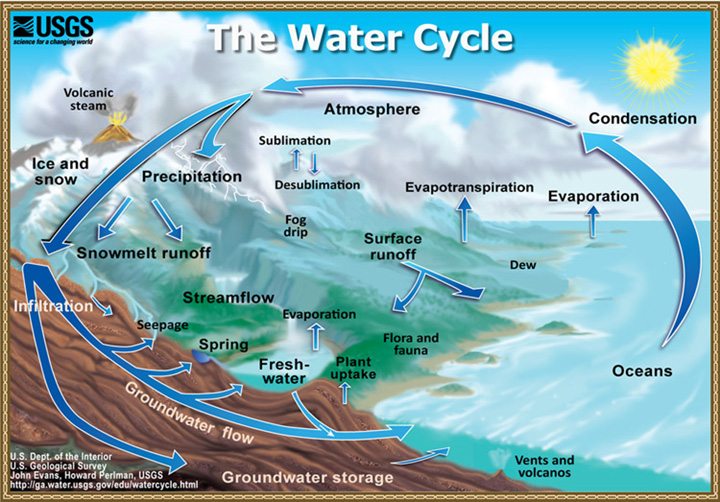
One example of a route through the water cycle is evaporation from the oceans, precipitation over the mountains, and flow through rivers back to the ocean. What parts of the water cycle do you encounter in your daily life?
The continual recycling of water and its precipitation plays an important role in determining the nature of Earth’s surface. Water is the major agent of weathering and erosion on Earth. Water can dissolve and break apart rocks. Water freezing in cracks in rocks can physically break them apart.
Water transports rock fragments, a process called erosion. Erosion carries rock particles from elevated to lower areas. Eroded sediments suspended in water can be carried large distances. These sediments increase the erosive capabilities of streams and rivers. Glaciers also erode the landscape. Typical landforms formed by water are valleys, canyons, underground caves, and sinkholes.
Eroded sediments are deposited in low-lying areas or out to sea. These sediments may produce river deltas and wetlands. Substances that are dissolved by water can be recrystallized when the water evaporates. Examples of this can be seen in salt lakes and pans.
Teacher Note: Practices
This item requires students to apply models of the water cycle to explain why disruptions in the water cycle are harmful. They use a model based on evidence to illustrate and predict the relationships between components of a system. Help them understand the significance of the water cycle by using the Pecha Kucha strategy. Provide students different topics on different drought and flooding events for them to research. The Pecha Kucha strategy is found on the Professional Learning tab. Click on Strategies & Resources, then Spotlight On Strategies (SOS). Pecha Kucha is found underneath Research.