Photosynthesis
How Does the Process of Photosynthesis Work?
The overall biochemical reaction for photosynthesisglossary term (opens in a new window) is a very complex process. This complex process can be divided into two main stages: the light-dependent reaction and the light-independent reaction or Calvin cycleglossary term (opens in a new window). Both these stages take place inside the chloroplasts.
The Light-Dependent Reaction
In the light-dependent reaction, solar energyglossary term (opens in a new window) is converted into potential chemical energy. The light-dependent reaction takes place in the thylakoidsglossary term (opens in a new window)—stacked, saclike structures found within the chloroplasts of plant cells. These structures contain the green pigment chlorophyllglossary term (opens in a new window). Chlorophyll absorbs wavelengths of light other than green. Other different-colored pigments may also be present and help to absorb light. However, chlorophyll is the most important of all for photosynthesis. The light-dependent reaction has two photosystems (II and I), and takes place in the following the following steps:
- Photosystem II occurs first. In Photosystem II, light is absorbed by chlorophyll molecules that excites electrons in the chlorophyll. These excited electrons are passed onto a series of proteins called an electron transport chain.
- Electrons are passed along this chain. At each link the electrons lose some of the energy they gained from the light. This energy is captured and used to convert ADP (adenosine diphosphate) to ATP (adenosine triphosphate). This process is called photophosphorylation. Water is split in this process. Hydrogen ions and oxygen are produced. Oxygen (from the water) is given off as a by-product.
- In Photosystem I the same electrons are reenergized by more light and passed down a second electron transport chain.
- The electrons passed down the second electron transport chain are used by the hydrogen ions to convert NADP (nicotinamide adenine dinucleotide phosphate) to NADPH (nicotinamide adenine dinucleotide phosphate hydrogen).
- The potential difference created by the electron transport chain resulting in a differing number of hydrogen ions on either side of the cell membrane, causes transport of a hydrogen ion down the gradient which provides energy for phosphorylation of ADP into ATP, mediated by ATP synthase.
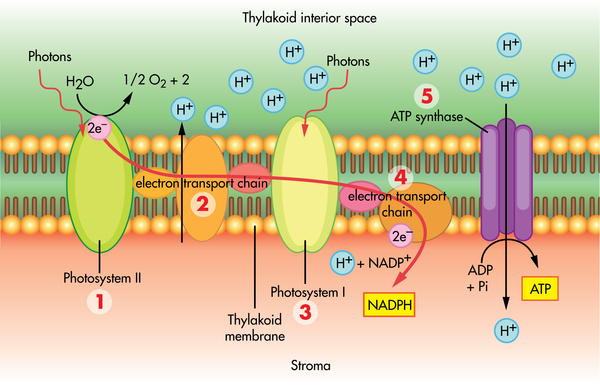
The light-dependent reactions of photosynthesis take place in thylakoids. Where are thylakoids located?
Notice that light is used twice in this process. First, light is used in Photosystem II to initially excite the electrons and make ATP and then split water. Then, light is used in Photosystem I to reenergize the electrons to make NADPH. So, in the light-dependent reaction, light energy has been converted into chemical potential energy in high energy molecules of ATP and NADPH (a source of high energy electrons.) These high energy molecules are passed on to the next stage of photosynthesis, the light-independent reaction.
The Light-Independent Reaction or Calvin Cycle
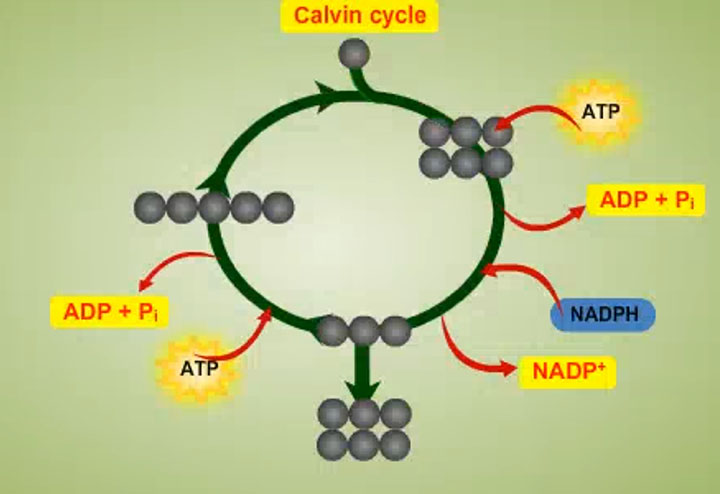
The Calvin cycle is a series of chemical reactions that use high-energy compounds made in the light-dependent reaction to make carbohydrate. Why is the Calvin cycle sometimes called the dark reaction?
The Calvin cycle takes place in the stromaglossary term (opens in a new window) of the chloroplastglossary term (opens in a new window). It uses carbon dioxide to make organic molecules that are then converted into sugars. No light is used in this part of photosynthesis; it is powered by ATP and NADPH from the previous light reaction. The steps are
- Carbon dioxide from the air is captured by existing organic compounds or CO2 acceptors. This process is called carbon fixation.
- The carbon from the carbon dioxide is then reduced through a series of steps by electrons provided by the NADPH produced from the light reaction.
- With help from energy provided by ATP (also from the light reaction), a sugar-like compound containing three carbons called glyceraldehyde-3-phosphate is made. Some of this exits the Calvin cycle and is used to make glucose.
In the light-independent reaction, carbon from carbon dioxide is fixed into organic molecules that are then turned into sugars. These can be used to make other organic compounds. These compounds may be used by the plant directly or passed down the food chain.
Teacher Note: Practices
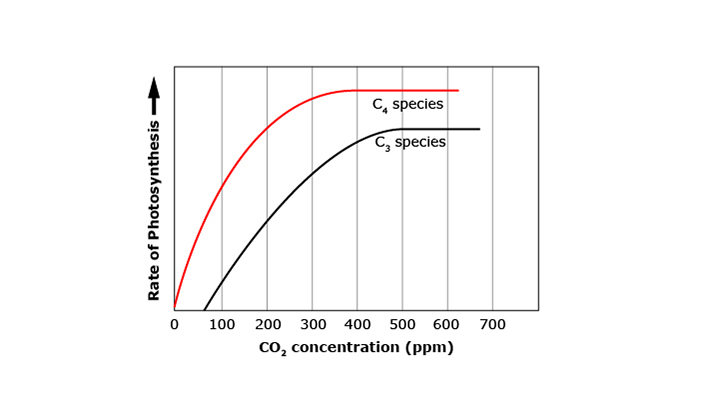
In this item, students interpret two curves illustrating the differences between carbon dioxide usage and photosynthesis in two species of plants. They analyze data using models in order to make valid and reliable scientific claims. Help them interpret the graph using the Hot Potato strategy. As they examine the data, have them pose questions that pertain to the graph. The Hot Potato strategy is found on the Professional Learning tab. Click on Strategies & Resources, then Spotlight On Strategies (SOS). Hot Potato is found underneath Questioning.