Asexual and Sexual Reproduction
Applying Asexual and Sexual Reproduction
Understanding the processes of sexual reproductionglossary term (opens in a new window) has helped scientists develop treatments for fertility. Many couples have difficulty getting pregnant on their own. They often turn to fertility treatments to assist with the natural reproduction processes.
One such treatment is called in vitro fertilizationglossary term (opens in a new window) (IVF). The couple’s own sperm and egg are used in this process. However, they are collected from each parent and joined outside of the woman’s body. The fertilization process takes place in a laboratory under ideal conditions. In order to increase the chances of getting pregnant, more than one egg is fertilized. The eggs are monitored to be sure that mitosisglossary term (opens in a new window) begins and an embryo develops.
After the embryos divide to about four cells, they are implanted into the woman’s uterus. Again, more than one embryo is usually implanted in order to increase the chances for success. This is also the reason that multiple births, such as twins and triplets, are more common among couples who undergo IVF compared to those who achieve pregnancy naturally.
In vitro fertilization is often an effective method for achieving pregnancy. Although it comes with its critics, IVF is one way science is changing and improving lives.
STEM and Asexual and Sexual Reproduction
Advances in technology are changing the face of reproduction. Processes that could previously only be done sexually with an egg and a sperm are becoming asexual. SCNT, commonly known as cloning, is just one such method.
Researchers have developed two distinct uses for cloning: reproductive cloning and therapeutic cloning. In reproductive cloning, scientists remove nuclear genetic material from egg cells and replace it with genetic material from the nucleus of a somatic (non-reproductive) cell. This egg cell is then transferred into the uterus to develop into a baby whose genotype is an exact duplicate of the somatic cell. Reproductive cloning has been tested in animals, including sheep, mice, cats, and dogs, but is considered unethical in humans.
Therapeutic cloning uses a similar method, but the goal is different. The resulting embryonic cells (that is, pluripotent stem cells) are treated to develop not into whole organisms, but into particular tissues or organs. The hope is that the stem cells will replace harmful or damaged cells for people with certain diseases such as Alzheimer’s and cancer.
Individual genes can also be cloned. Molecular biologists replicate the process of genetic recombination in the lab, splicing together desirable nucleotide sequences. They then insert the so-called recombinant DNA into bacteria, which replicate the DNA to create many, many copies. The recombinant DNA can be used to create novel proteins; can be inserted into other organisms, which are then known as genetically modified organisms; or can be used to treat disease. The possibilities are endless, but is DNA cloning ethical?
SCNT and molecular cloning technologies raise many concerns and a lot of controversy. Will this lead to human cloning? The debate remains. Many people wonder if this new technology that may be able to treat life-threatening diseases is worth the price of the ethical issues that come with it.
Teacher Note
Purpose: to evaluate student ability to interpret graphs and to explain concepts learned in lesson. Suggested use: think-pair-share then write response.
-
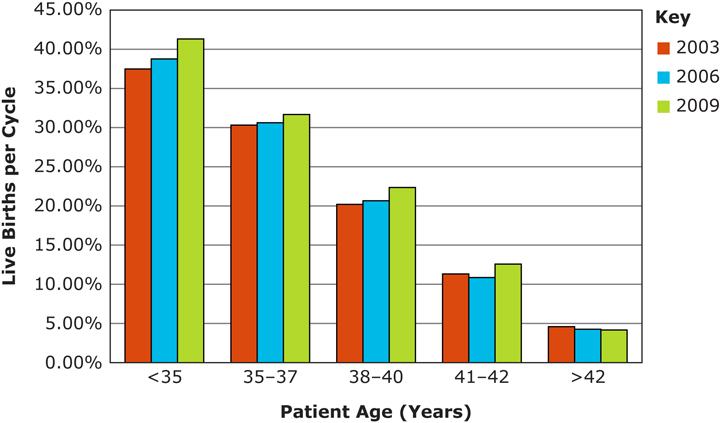
<div tinymce="true" use-dimensions="false">Study the graph and explain the role of maternal age in the success of the IVF procedure.<br></div>Study the graph and explain the role of maternal age in the success of the IVF procedure.Press Space or enter key to Enter Text
-
<div tinymce="true" use-dimensions="false">What do you notice about the three different years for which data are shown? What could explain this pattern?<br></div>What do you notice about the three different years for which data are shown? What could explain this pattern?Press Space or enter key to Enter Text