Asexual and Sexual Reproduction
What Are the Differences between Asexual and Sexual Reproduction?
Teacher Note: Connections
As students engage with each of the lesson questions in this concept, they will build on their understanding of the cell as a system. Students will examine the properties of the parts of the cell involved in reproduction, and their structures and interconnections, to reveal the function of the reproductive system in both sexual and asexual organisms. They will deduce the functions and properties of reproductive structures from their overall structure, the way their components are shaped and used, and the molecular substructures of their various materials.
As students read and comprehend complex texts, view the videos, and complete the interactives, labs, and other Hands-On Activities, have them summarize and obtain scientific and technical information. Students will use this evidence to support their initial ideas on how to answer the Explain Question or their own question they generated during Engage. Have students record their evidence using “My Notebook.”
Asexual Reproduction
Because asexual reproductionglossary term (opens in a new window) and sexual reproductionglossary term (opens in a new window) differ in the number of parents needed to produce an offspring, it is no wonder that the methods differ as well.
Asexual reproduction is most common among microorganisms, but other species are able to reproduce this way as well. There are several forms of asexual reproduction. Bacteria usually reproduce through binary fission. A cell replicates its DNA then divides into two daughter cells each with identical genetic material.
Teacher Note: Misconception
Students may think that asexual reproduction is restricted to microorganisms only. Although it is the most common form of reproduction in microorganisms, other living things also reproduce asexually. Regeneration, parthenogenesis, and internal budding are all forms of asexual reproduction that larger life forms undergo. For example, echinoderms and many plant species regenerate, some insects such as bees and wasps undergo parthenogenesis, and sponges bud internally.
Certain plants can reproduce through a process called vegetative reproduction. A new plant can be generated by division of the roots, stems, or leaves of a parent plant. Raspberries, for example, can generate offspring using only their stems. As with all asexual reproduction, the offspring have identical DNA to the parent.
Teacher Note: Misconception
Students may not understand that plants can sexually reproduce. Since they do not copulate, it might not seem obvious that plants reproduce sexually, but pollination is one component of sexual reproduction in some plants.
Budding and regeneration are two more methods of asexual reproduction in animals. In budding, a new organism grows out of the parent's body. Sometimes the offspring remain attached to the parent's body and sometimes they break off. Hydras are simple aquatic animals that can reproduce by budding.
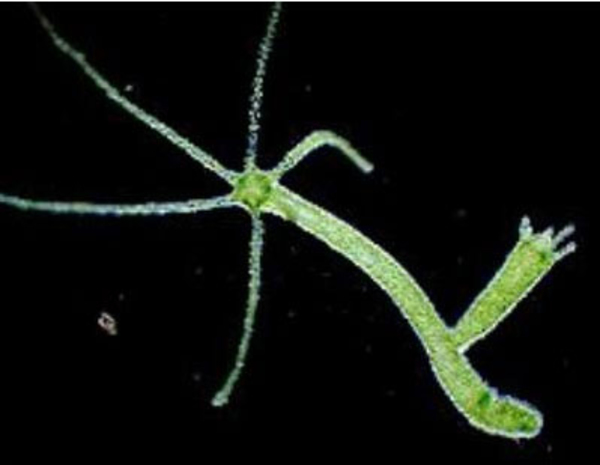
A new offspring buds off the side of this hydra. How does the genotype of the budded offspring compare to the parent?
Regeneration is similar to vegetative reproduction. A piece of the parent's body can develop into a new organism. For example, if one arm of a sea star is cut off, not only will the sea star grow that arm back, but the lost arm also may grow into an entirely new sea star. Regeneration can only occur if the detached piece of the parent contains enough genetic information.
Teacher Note: Misconception
Students may associate asexual reproduction with weakness and sexual reproduction with strength. This misconception arises from the fact that many of the complex organisms we are familiar with reproduce sexually. However there are advantages to asexual reproduction. These include rapid reproduction, large numbers of offspring, and little energy cost to the parent.
Sexual Reproduction
Sexual reproduction always involves combining genetic material from two organisms to produce offspring. The simplest form of sexual reproduction is conjugation in which two individuals fuse together and exchange genetic material, then separate again. Some algae use conjugation to sexually reproduce.
For most multicellular organisms, sexual reproduction is their primary means of reproduction. In non-conjugation sexual reproduction, sex cells are produced by a process called meiosisglossary term (opens in a new window). These sex cells are called gametes. The male gametes are called the sperm, the female gametes are called ova or eggs. When an egg and sperm fuse together in the process of fertilizationglossary term (opens in a new window), a zygote is formed. A zygote is a fertilized egg, and it has the potential to grow into a new organism.
The process of fertilization differs widely. Organisms have a wide variety of life cycles and structures that have evolved to ensure fertilization.
Flowering plant species go through pollination. The male stamen produces pollen containing the male gamete. Pollen is carried by wind, insect or other mechanisms to a female pistil that contains the ovary. Flowers are an adaption to ensure that pollination occurs.
Animal species have two main methods of fertilization: external and internal. In external fertilization, the male and female release their sperm and eggs into the surrounding environment. Fertilization then takes place. Aquatic species such as amphibians and employ this type of sexual reproduction.
Many other animals reproduce internally. The egg remains inside the female’s body and the sperm travels to meet it there. Many organisms have evolved into complex organs, and mating displays and rituals have been developed to ensure this happens. Some groups of animals, such as mammals, retain the fertilized egg and developing baby in the body until birth. Others, like birds and some reptiles, lay the fertilized eggs in a nest, protect the eggs, and raise the young when they hatch.
Teacher Note: Misconception
Students may believe sexual reproduction always involves mating. They may focus on mammalian reproduction. However, sexual reproduction only requires the fusion of male and female gametes. This can occur in several different ways other than copulation, including pollination, amplexus, and other forms of external fertilization. In addition, students may not understand that plants can sexually reproduce. Since they do not copulate, it might not seem obvious that plants reproduce sexually, but pollination is one component of sexual reproduction in some plants.
Teacher Note: Practices
This item allows students to apply scientific reasoning, theory, and/or models to link evidence to claims about sexual and asexual reproduction to assess the extent to which the reasoning and data support the explanation regarding their similarities and differences. Extend this item by having students create a two-column chart with headers “Asexual Reproduction” and “Sexual Reproduction” into which they add descriptions of organisms according to their mode of reproduction. This can be an ongoing project throughout the remainder of the lesson, giving students the opportunity to research and obtain information about different types of organisms and communicate this information via their charts.