Asexual and Sexual Reproduction
What Are the Differences between Mitosis and Meiosis?
A Comparison of Meiosis and Mitosis
Mitosisglossary term (opens in a new window) and meiosisglossary term (opens in a new window) both involve cell division. However, it is important to remember that these two processes have major distinctions as summarized in the table.
| Mitosis | Meiosis | |
| Types of Cells Involved | somatic cells | gametes |
| Types of Organisms Involved | all eukaryotes | only those that reproduce sexually |
| Number of Divisions | 1 | 2 |
| Final Number of Daughter Cells | 2 | 4 |
| Final Chromosome Number | same as parental number (diploid) | half the parental number (haploid) |
| DNA Replication | always occurs in S-phase before | always occurs before meiosis I |
| Homologous Chromosomes | no pairing occurs | complete pairing occurs during prophase I |
| Crossing Over | none; there is no exchange of DNA | during prophase I of meiosis I; DNA of homologous chromosomes can be exchanged |
| Chromosomes Separate at Centromere | during anaphase | only during anaphase II |
| Daughter Cell Genotype | identical to parent cell | differ from parent cell because of crossing over |
Mitosis and Meiosis
The phases of mitosis and meiosis are similar, but there are differences between these important cellular processes. During which phase of meiosis do maternal and paternal chromosomes swap genes?
Teacher Note: Practices
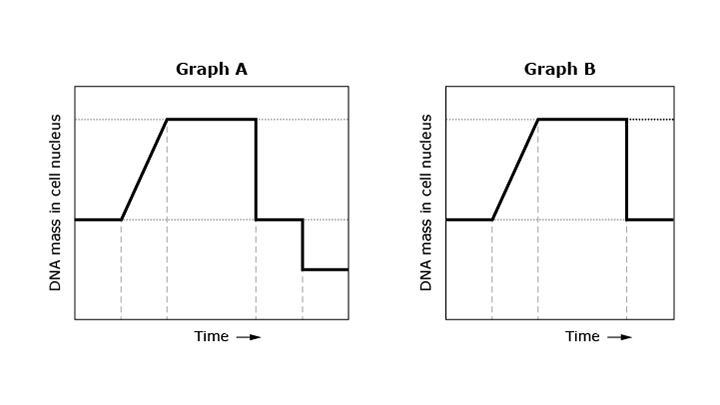
This item requires students to analyze and interpret data presented in graph form using tools, technologies, and/or models (e.g., computational, mathematical) to make valid and reliable scientific claims about changes taking place during mitosis and changes taking place during meiosis. Extend this item by having students draw cell models showing changes in chromosomes at different stages that coincide with the changes in DNA mass on each graph.
Use your knowledge of the differences between mitosis and meiosis to analyze the two graphs shown. One represents a cell undergoing one round of mitotic division and the other represents a cell undergoing one round of meiotic division. Identify which graph represents mitosis and which represents meiosis. Then justify your answers by explaining each change in DNA mass with time for each graph.
Press Space or enter key to Enter Text