Asexual and Sexual Reproduction
What Are Fertilization and Development?
Fertilization
Ova and sperm serve the single purpose of producing an offspring. The first step to this goal is fertilizationglossary term (opens in a new window). Fertilization is the fusion of an ovum with a sperm.
During intercourse, millions of sperm are released into a female’s vaginal opening. A protective layer containing binding sites for the sperm surrounds the egg. Enzymes from the sperm head break down the egg’s protective layer. This allows a single sperm to enter the egg.
Following fertilization, the egg is activated and undergoes a series of changes. One such change is the formation of a protective barrier that prevents other sperm from entering. The single sperm that has already entered the egg penetrates the egg cytoplasm. The sperm's nuclear envelope disappears. The sperm chromatinglossary term (opens in a new window) unwinds and loosens. This process is called decondensation. Chromatin from both egg and sperm are soon surrounded by a nuclear envelope. The genomes of the two haploid (N) cells fuse to form a single diploid cellglossary term (opens in a new window) (2N). The diploid cell contains a complete set of chromosomes from each parent. The fertilized cell is called a zygote. It will continue to develop into an embryo.
Development of an Embryo
Almost immediately after its formation, the one-celled zygote begins to undergo mitosisglossary term (opens in a new window). Cell division allows an organism to grow and develop.
- As the embryo travels toward the uterus, it undergoes several divisions. It progresses from one cell through 2-cell, 4-cell, 8-cell, 16-cell, and 32-cell stages to form a solid ball of cells called a morula.
- A morula contains approximately 64 cells.
- As the cells continue to divide, a cavity develops in the center of the morula. The resulting hollow ball of cells is called a blastula.
- During implantation, the blastula attaches to the wall of the uterus.
- As the embryo continues to develop, the single-layered blastula divides into three layers during a process called gastrulation.
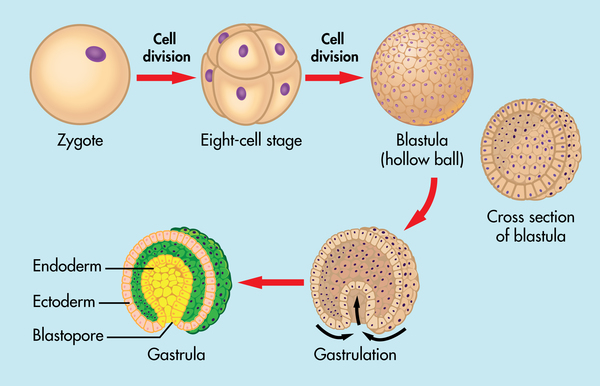
Gastrulation is the beginning of cell differentiation. During gastrulation, the single-layered blastula divides into how many layers?
The three layers of cells consist of the ectoderm, mesoderm, and endoderm. They will ultimately form all the tissues and organs of the organism. The ectoderm will develop into the skin and nervous system. Mesoderm cells will become most of the internal structures. These include the bones, muscles, and blood cells. The endoderm will become the cells that line digestive organs, as well as the respiratory and excretory systems.