Asexual and Sexual Reproduction
What Are Haploid and Diploid Cells?
Haploid Versus Diploid
Not all cells of the human body are alike. There are nerve cells, blood cells, and muscle cells to name a few. Although these cells serve different functions, all are somatic, or body, cells. Somatic cells are diploid cells. They contain two complete sets of parental chromosomes. Diploid cells are often labeled as 2N. The 2 represents the fact that for every chromosome, there are two homologous copies—one from the organism’s maternal parent and one from the organism’s paternal parent.
Other cells, the egg and sperm cells, are haploid cells (N). They contain only a single set of chromosomes, or half the parental number. When the haploid cells of the egg and sperm come together, the resulting cell will be diploid—the combination of two haploid cells.
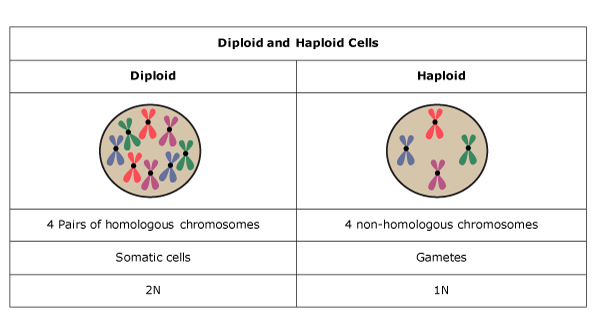
Study the image and refer to the text. What is the purpose of these different cells?