Asexual and Sexual Reproduction
What Is Somatic Cell Nuclear Transfer (SCNT)?
Reproductive Technology
In a search for better ways to treat diseases and heal injuries, scientists have developed ways to manipulate reproduction. One such method is called somatic cell nuclear transferglossary term (opens in a new window) (SCNT). It allows scientists to implant DNA of a somatic cell (a non-reproductive, body cell) into an egg. The desired organism can then grow and develop with the newly inserted DNA.
The process of SCNT begins by removing the nucleus of a somatic cell. The remainder of the cell is discarded. The nucleus of an egg cell is also removed. However, the nucleus is discarded, leaving all other parts intact. The somatic cell nucleus is inserted into the enucleated egg cell. There, its newly implanted DNA reprograms it as a diploid cellglossary term (opens in a new window). To begin cell division, the egg is stimulated with an electric shock. After several rounds of mitosisglossary term (opens in a new window), a blastula forms and the organism grows as a normal zygote. However, the DNA of the zygote is identical to the DNA of the original somatic cell. An organism that might normally only exist from the sexual reproductionglossary term (opens in a new window) between an egg and a sperm now exists as a clone. This feat of science is great, but also comes with great controversy.
Teacher Note: Connections
In completing this item students observe patterns in reproductive systems at different scales (both molecular and organismal) and cite patterns as empirical evidence for causality in supporting their explanations of the type of reproductive technology used to produce three calves. You may wish to have a short class discussion before assigning this item to talk about the similarities and differences between SCNT and In Vitro Fertilization (IVF) techniques. After students have completed this item, extend student learning by having them draw sketches to show steps in these two processes. Ask students to use their drawings to justify the answers they chose in this assessment item.
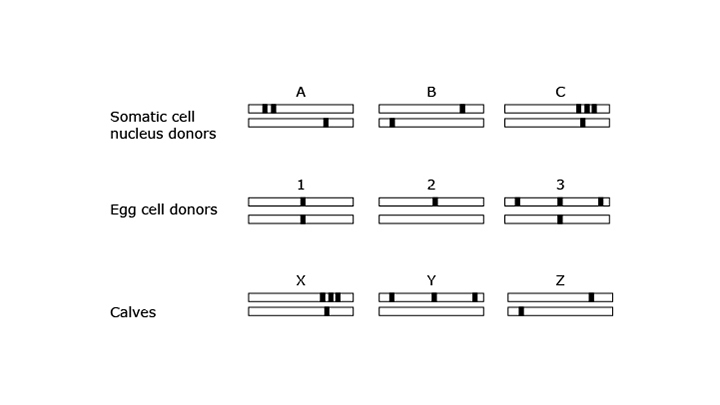
The embryos produced by both SCNT and IVF methods were implanted into surrogate mother cows. These cows then carried the fetuses to term. After birth, calves underwent genetic testing and the same regions of the same homologous chromosomes shown for the donor cows were analyzed. The results for three calves (Calves X, Y, and Z) are shown. Based on the data, what can you conclude about the method for producing each calf? Choose the method that applies to each calf from each drop-down menu.