Asexual and Sexual Reproduction
What Is the Function of Each Stage of Meiosis?
Meiosis and Its Function
Egg and sperm cells are called gametes. The haploid cells of the gametes are created in a two-part cell division process called meiosisglossary term (opens in a new window). Only organisms that reproduce sexually undergo meiosisglossary term (opens in a new window).
During the two stages of meiosis, the number of chromosomes in the parental diploid cells is reduced by half. In the end, four haploid daughter cells are produced. Before meiosis I begins, DNA replication occurs. Each chromosome is duplicated to form sister chromatids connected by a centromere. Then meiosis begins, following the steps outlined below.
Meiosis I
- Prophase I: chromosomes condense and homologous chromosomes pair up. Homologous chromosomes are corresponding chromosomes from each parent. During prophase, chromosomes may cross over. Entire chromosomes or parts of the chromatids cross over one another and switch position. Crossing over (also called recombination) is a major contributor to genetic diversity.
- Prometaphase I: the nuclear envelope disappears and paired homologous chromosomes attach to spindle fibers.
- Metaphase I: paired homologous chromosomes line up in the middle of the cell.
- Anaphase I: paired homologous chromosomes separate and are pulled to opposite ends of the cell.
- Telophase I and cytokinesis: a nuclear envelope forms around each group of chromosomes. The cytoplasm divides, forming two haploid daughter cells.
The chromosomes were reshuffled and separated. Neither haploid daughter cell has the exact same set of chromosomes as the parents.
After meiosis I, the two haploid daughter cells enter a second stage of division.
Meiosis II
- Prophase II: chromosomes condense and the nuclear envelope begins to break down.
- Prometaphase II: the nuclear envelope disappears, spindle fibers form, and the sister chromatids attach to the spindle fibers.
- Metaphase II: the chromosomes line up in the center of the cell.
- Anaphase II: sister chromatids separate at the centromere and are pulled to opposite ends of the cell.
- Telophase II and cytokinesis: a nuclear envelope forms and the cytoplasm divides into separate cells.
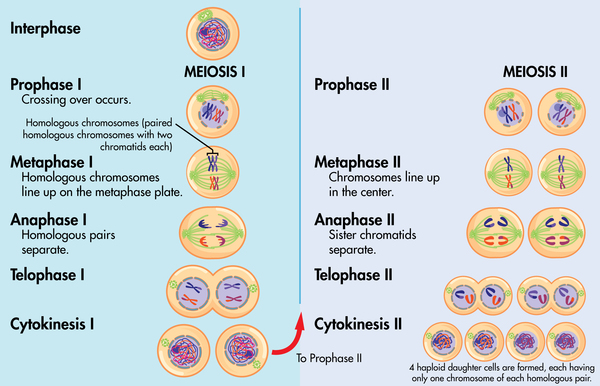
A diploid cell goes through two stages of meiosis to produce four haploid cells. What are sister chromatids and how are they formed?
At the end of meiosis II, there are a total of four haploid cells. Meiosis II is similar to mitosisglossary term (opens in a new window), which is the process of cell division in body cells. However, the chromosomes resulting from meiosis II are no longer identical because they have undergone recombination.
Teacher Note: Connections
These items engage students in actively processing the changes taking place in cells during meiosis. These items are good assessments to assign just after students have completed the exploration, “Exploring Asexual and Sexual Reproduction.” In this item, students understand much of science deals with constructing explanations of how things change and how they remain stable. They quantify and model changes in reproductive systems over very short or very long periods of time. They see some changes are irreversible, and negative feedback can stabilize a system, while positive feedback can destabilize it. They recognize systems can be designed for greater or lesser stability. As a follow-up activity, ask students to write explanatory sentences to accompany the flow chart they completed in the second item. The sentences should explain the basis for the change at each level of the flow chart.