Asexual and Sexual Reproduction
What Are the Effects of Non-Disjunction?
Non-Disjunction
Given all the complex processes involved in reproduction, it is no wonder that abnormal outcomes sometimes occur. When this happens during meiosisglossary term (opens in a new window), it is referred to as non-disjunction. When chromosomes fail to separate properly during anaphase I or II, the number of chromosomes in the daughter cells is imbalanced.
Non-disjunction can lead to aneuploidyglossary term (opens in a new window), which is a condition in which an offspring has an abnormal number of chromosomes. Monosomyglossary term (opens in a new window) is the condition in which a daughter cell is missing a chromosome or part of a chromosome from one parent. Trisomyglossary term (opens in a new window) is a condition in which a daughter cell receives an additional chromosome from one of the parent cells.
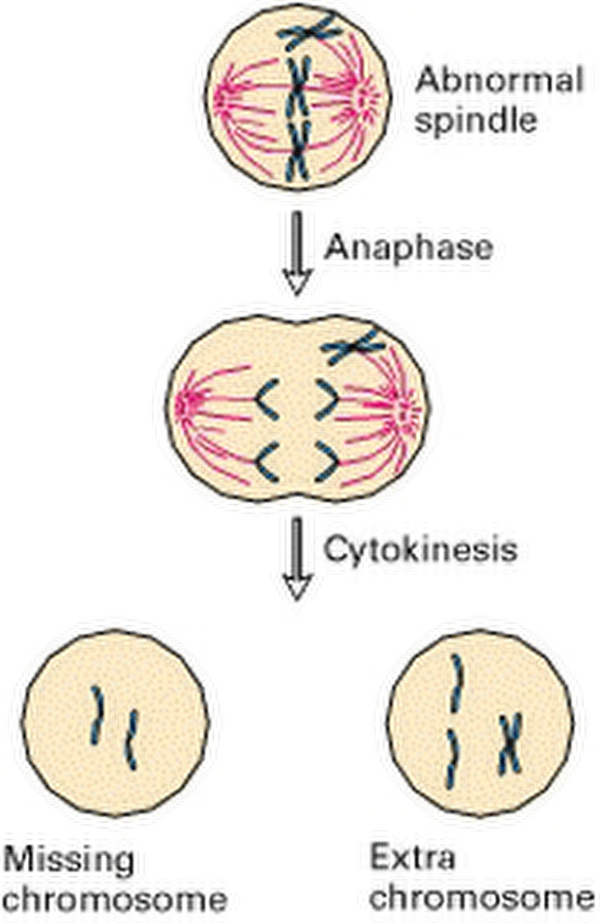
Non-disjunction results in an abnormal number of chromosomes following cell division. What is an example of a genetic disorder caused by non-disjunction?
Non-disjunction can affect the number of sex chromosomes inherited by an individual. Recall that normal females possess two X chromosomes and normal males possess one X and one Y chromosome. Any discrepancies in these normal pairings result in sex-linked disorders among surviving offspring.