Cell Structure and Function
What Are the Three Parts of the Cell Theory?
Teacher Note: Connections
In this concept, students will explore the structure of cells and will understand how their parts function together. Students will examine the key parts and properties of cells and will question how they relate to each other. They will investigate cells by examining the structures of different organelles and their interconnections to reveal the overall function of the cell. Help students understand the structure and function of cells and cell parts by having them draw or write key concepts in their journal. The Journals strategy is found on the Professional Learning tab. Click on Strategies & Resources, then click on Spotlight On Strategies (SOS). Then click on Key Ideas and Details and Spotlight On Strategies: Journals.
As students read and comprehend complex texts, view the videos, and complete the interactives, labs, and other Hands-On Activities, have them summarize and obtain scientific and technical information. Students will use this evidence to support their initial ideas on how to answer the Explain Question or their own question that they generated during Engage. Have students record their evidence using My Notebook.
The Cell Theory
Cells were discovered in 1665 when the scientist, Robert Hooke, observed cork through a microscope. As he examined the cork, he saw tiny sections that looked like small rooms, or cells. To this day we use the term cell to refer to these basic units of life. Other scientists went on to study living cells and to improve the microscope so that cells could be more closely examined. Based on their work, the concepts underlying cell theoryglossary term (opens in a new window) were developed. Cell theory has three main parts:
- All living things are made of one or more cells.
- The cell is the basic unit of structure, physiology, organization, and function in living things.
- Every cell arises from a preexisting cell.
Living Things Are Made of Cells
Teacher Note: Misconception
Students may believe that cells are flat, two-dimensional units. In fact, they are three-dimensional structures, even though they may appear to be flat in pictures or under a microscope.
Although organisms vary widely in their appearance, all living things are composed of one or more cells. These cells are the basic units, or building blocks, of life on Earth. Just as building blocks can be used to create many different structures from cars to castles, cells are units that form many different living things. Most cells are very small. The unaided human eye can see objects that are about 0.1 mm long; therefore, you may be able to see larger cells, like a human egg. To see smaller cells, you will need a microscope. Generally, plant and animal cells are between 0.1 and 0.005 mm long. Bacterial cells are usually smaller and Mycoplasma spp are known to be the smallest cells. Some cells are unusually large, like an ostrich egg cell.
Cells Are Basic Units of Life
The structure and physiology, or function, of living things can be analyzed at the cellular level. The different types of cells in an organism determine how the organism as a whole appears and behaves. Although the various cells carry out different tasks, the cells within an organism do not function independently. Cells are organized into tissues. Tissues are groups of cells that work together for a particular purpose. Different tissues are organized into larger components—the organs—and many of these organs function together as organ systems. Humans have many different organ systems, including the circulatory, respiratory, and nervous systems. Together these systems regulate how the body functions and responds to its environment.
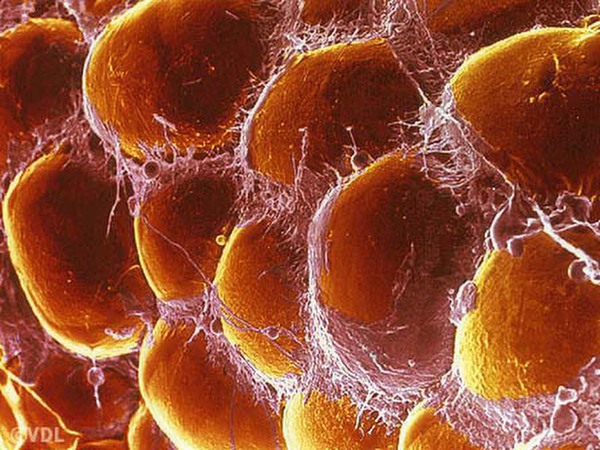
Adipose tissue is made of the same type of cells that together store fat. Where do you think these cells are found in the human body?
Teacher Note: Misconception
Students may think that all cells are the same. In fact, there are numerous types of cells with specialized structures for different functions.
Cells Arise From Preexisting Cells
All cells arise from preexisting cells. For unicellular (or one-celled) organisms, the production of a new cell results in a new organism or its progeny. For example, bacterial cell division results in an increase of the single-celled population. In multicellular organisms however, new cells increase the size of tissues and replace old or damaged cells. The process of making new cells (regeneration) allows organisms to grow and to recover from sickness and injuries by the formation of new cells and tissues. Studying this process helps doctors and scientists understand how organisms develop and how to treat damage or disease.
Teacher Note: Practices
In this item, students will construct an argument as to why humans meet the criteria of the cell theory using scientific evidence. To prepare for this activity, use the Hot Potato strategy to help students think about the components of the cell theory. Have them ask questions regarding what makes different living things meet the cell theory requirements. The Hot Potato strategy is found on the Professional Learning tab. Click on Strategies & Resources, then click on Spotlight On Strategies (SOS). Now click on Questioning, then click on Spotlight On Strategies: Hot Potato.