Cell Structure and Function
What Structures Make Up Cells?
Components of Prokaryotic Cells
Teacher Note
It may be difficult for students to keep track of the numerous subcellular structures found in cells. Encourage continued use of the Journals strategy by keeping a running list in the classroom of the name and function of each structure. Have students draw pictures to help them visualize the structures.
The prokaryotic cells of bacteria and archaea have simple organization and lack membrane-bound organelles, but they have distinct components that carry out important functions within the cell. In prokaryotic cells, DNA is coiled up in a region within the cytoplasm called the nucleoid. This DNA usually consists of a single, circular chromosome. Unlike the nucleus of eukaryotic cells, a membrane does not enclose the nucleoid. Prokaryotic DNA is in direct contact with the cytoplasm, a gel-like component that contains subcellular structures. Prokaryotic cells may also contain plasmids which are relatively small, circular DNA molecules. Plasmids contain fewer genes than the nucleoid’s DNA strand, and their genes are not needed for normal cell functions. However, plasmids confer useful properties, such as antibiotic resistance in some bacteria. Structures called ribosomes are also found in prokaryotic cells. Ribosomes are small bodies within the cell. Ribosomes are involved in protein synthesis. In prokaryotic cells, the ribosomes are suspended in the cytoplasm.
Prokaryotic cells are enclosed by a cell membraneglossary term (opens in a new window). The cell membrane serves as a barrier to unwanted chemicals and allows cells to recognize one another. A key function of the cell membrane is to control which substances move into and out of the cell. Photosynthetic prokaryotic cells may also have inner membranes called thylakoids, which facilitate photosynthesis. Outside the cell membrane, most prokaryotic cells have a cell wall that protects the cell and gives it a specific shape. Some bacteria have an outer covering called a capsule. The capsule is a hard coat that retains moisture and prevents the bacteria from being engulfed and destroyed by other cells.
Components of Eukaryotic Cells
Teacher Note: Misconception
Students may be unaware of the complexity of cells or think that because they are very small, they have a very simple structure. This misconception is created in part by simple models or a simplistic diagrammatic representation of cells. Cells are very complex and dynamic. When using simplistic images to help explain cells, make sure you emphasize that they are simplified representations of real cells.
Eukaryotic cells are larger and more complex than prokaryotic cells and are found in plants, animals, fungi, and protists. The membrane-bound subcellular structures in eukaryotic cells are highly specialized and called organelles. These subcellular structures are present in the cytoplasm or cytosolglossary term (opens in a new window). The membrane surrounding an organelleglossary term (opens in a new window) isolates it from rest of the cellular components, thereby allowing it to carry out specific functions. A cell or plasma membrane also encloses the entire cell, containing the cytoplasm and separating the cell from its environment. Some eukaryotic cells also have a tough cell wall surrounding the cell membrane.
Nucleus
Not all eukaryotic cells are the same, but they do share many of the same organelles. One organelle that is present in all eukaryotic cells is the nucleus. Most of the cell’s genetic information, in the form of deoxyribonucleic acid (DNA), resides within the nucleus. Like other organelles, a membrane encloses the nucleus. It serves as the control center of the cell, carrying genetic material and instructions for making proteins and other important molecules.
The nucleus can occupy up to 20 percent of the volume of a typical eukaryotic cellglossary term (opens in a new window). The nucleus is surrounded by a double-layered membrane called the nuclear envelope. This membrane is connected to the endoplasmic reticulum. The membrane has tiny nuclear pores. Nuclear pores provide a route for the movement of large molecules, like proteins and RNA, into and out of the nucleus. Most of the cell’s DNA is found inside the nucleus. The DNA is organized on structures called chromosomes. Chromosomes consist of DNA, proteins, and some RNA. This granular complex is called chromatinglossary term (opens in a new window). The nucleus also contains filaments that organize its contents. A spherical structure, called the nucleolus, can be seen inside the nucleus. The nucleolus is rich in ribose nucleic acid (RNA).
The functions of the nucleus include the organization, protection, and expression of the DNA. The nucleolus is where ribosomes are made. Ribosomes are made from RNA and associated proteins and play an important role in the cell’s manufacture of proteins.
Endoplasmic Reticulum
Another type of organelle found in most eukaryotic cells is the endoplasmic reticulum (ER). There are two kinds of ER: rough ER is the site of protein synthesis. Rough ER is named such because it has ribosomes on its surface that manufacture proteins. These newly synthesized proteins are imported into the ER machinery where they are modified and then exported into the cytoplasm or cell membrane. Smooth ER with no ribosomes on its surface produces lipids, detoxifies chemicals, and transports materials throughout the cell. Liver cells, which are involved in detoxification processes, contain large amounts of smooth ER. The ER works closely with another organelle called the Golgi apparatus, or Golgi body. The Golgi apparatus modifies and packages proteins from the ER and sends them to other parts of the cell. Proteins processed by the Golgi apparatus may be transported to the cell membrane to be released from the cell.
Other Organelles
Other structures found in eukaryotic cells include mitochondriaglossary term (opens in a new window), lysosomes, vacuoles, and chloroplasts.
- Mitochondria are oblong or ovoid organelles that serve as the power packs of the cell. The mitochondria convert chemical energy obtained from food into energy-rich compounds, which are released as the cell’s stored energy.
- Lysosomes are structures that contain digestive enzymes. These enzymes break down food like lipids, carbohydrates, proteins, and waste material into simpler molecules.
- Vacuoles are fluid-filled, sac-like structures enclosed within a membrane. Some eukaryotic cells store nutrients, water, and waste products in vacuoles. The size and function of vacuoles differ for plant cells and animal cells. Plant cells have big vacuoles that help support its structures and help maintain the cell’s homeostasis.
- Chloroplasts, found in some plant cells, contain the green pigment, chlorophyll. These organelles produce sugars and starches via the process of photosynthesis.
- Centrosomes are small cylindrical structures found in animal cells. They are involved in the regulation of cell division.
- Peroxisomes are small, membrane-enclosed organelles. They contain enzymes involved in metabolic reactions, like the breakdown of long chain fatty acids.
The Cytoskeleton
Both prokaryotic and eukaryotic cells have an internal system of network fibers called a cytoskeletonglossary term (opens in a new window). The cytoskeleton helps the cell maintain its shape and helps to transport materials. It is also important for cell division.
The cytoskeleton of eukaryotic cells is comprised of three types of protein fibers: microfilaments, intermediate filaments, and microtubules. Microfilaments, which are the thinnest of these structures, function in cellular movements, such as gliding and contracting, as seen in amoeba when they crawl on surfaces. Intermediate filaments provide mechanical support and are also involved in cell adhesion—sticking the cells to other cells and surfaces. Microtubules are hollow tubes that maintain cell shape and provide connections to transport organelles and large molecules within the cell. Microtubules also play an important role in cell division.
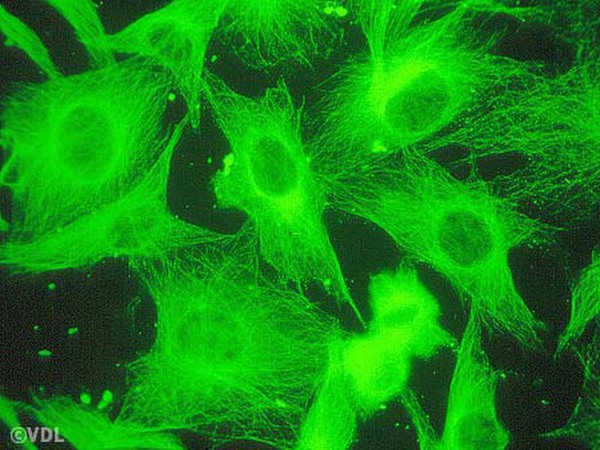
Microtubules, shown in green, are an important part of a cell’s cytoskeleton. What is the function of the cytoskeleton?
Cilia and Flagella
Some cells have organelles that extend from the main body of the cell. There are two main types—cilia and flagella. Cilia can be used for moving the cell, for moving substances outside the cell, or can be used as sensory devices. Those cilia that move cells are usually present in large numbers. Some small organisms use them to move around. Most of these belong to a group of protists called the ciliates. Multicellular eukaryotes use cilia in large numbers. The cilia of adjacent cells often work together. For example, cells lining the windpipe use cilia to sweep mucus and dirt away from the lungs. Other cilia are adapted to sense the environment around the cell.
Flagella on the other hand, are longer than cilia. They are usually present in fewer numbers. They have a whip-like movement that can propel a cell along. They are mostly found in protists and simple organisms, like sponges.
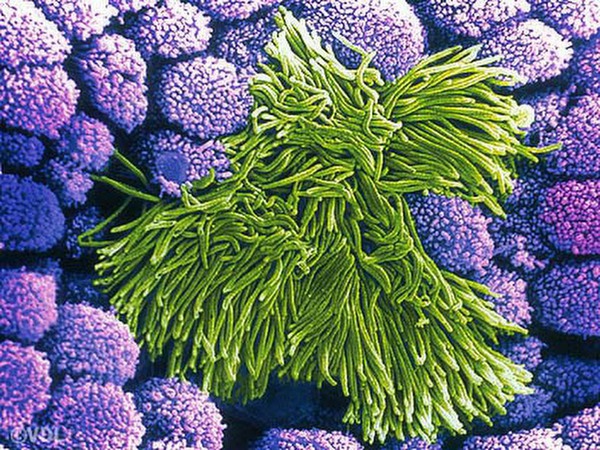
Cilia are in the trachea, or windpipe of humans. What is their function?